Search This Blog

Showing posts with label india buddha himalayas snow zanskar travel mulbek monastery suru river indus alchi. Show all posts

Sunday, June 19, 2011

August 2011: Himalayan Driving Holiday - Ladakh, Suru, Zanskar

TAG India is planning Driving Holiday in Ladakh during August-- September 2011. Dates for this program are from August 26th to September 11th. The cost of the programs is estimated to be approximately Rs 20,000/- * or 30,000/-* depending on the plan to include local transport, insurance, sightseeing, boarding & lodging and food at certain places.

*The cost may vary depending on the number of participants & need for luxury.
The cost does not include airfare, some food & personal expenditure.


The tentative schedule for the Driving Holiday is given below. It might vary slightly based on the weather & other conditions in Ladakh region.
The local transport in Leh would be 4-Wheel Drives. Sometimes we will be making our own routes, a la Lonely Planet! The days are sunny & windy; nights are cool/cold.


Plan A - 10 days from 27 August 2011 to 4 September 2011
(To include Indian Public Holidays on 31 August & 1 September)

Plan B - 16 days from 27 August 2011 to 11 September 2011
(To include
Indian Public Holidays on 31 August & 1 September & American Holiday on 5 September if applicable)
Do fill up the form at the following link if you are interested in joining us on this Driving holiday!


TENTATIVE SCHEDULE

Day 0 Friday 26-Aug-2011
Late Friday late night flight to Delhi & take an Friday early morning flight to Leh from Delhi


Day 1 Saturday 27-Aug-2011
Reach Leh; Acclimatize


Day 2 Sunday 28-Aug-2011
Pangong Tso


Day 3 Monday 29-Aug-2011
back to leh - Relax


Day 4 Tuesday 30-Aug-2011
Tso Moriri


Day 5 Wednesday 31-Aug-2011
back to Leh via Tso Kar & Tanglang La - Relax


Day 6 Thursday 01-Sep-2011
Enjoy Ladakh Festival; Relax in Leh or do local sight seeing;


Day 7 Friday 02-Sep-2011
Via Khardung La to Nubra Valley


Day 8 Saturday 03-Sep-2011
Nubra to Leh


Day 9 Sunday 04-Sep-2011
Part A – Fly back to Bangalore
Part B – Leh to Alchi, Lamayuru, Kargil


Day 10 Monday 05-Sep-2011
Kargil to Parachik


Day 11 Tuesday 06-Sep-2011
Parachik via Rangdum to Padum


Day 12 Wednesday 07-Sep-2011
Padum to Rangdum


Day 13 Thursday 08-Sep-2011
Rangdum to Kargil


Day 14 Friday 09-Sep-2011
Kargil to Dah/Alchi


Day 15 Saturday 10-Sep-2011
Alchi/Dah to Leh


Day 16 Sunday 11-Sep-2011
Fly from Leh to Delhi in the morning flight. Take the evening flight from Delhi to Bangalore (EOJ)

Sunday, August 1, 2010

From Leh to Kargil in a day by Roopa Sreedhar

© TAG INDIA www.tagindia.net

On my journey to Kargil

I have lost count of the villages, towns, cities I have visited in all my travels & treks in India. Everywhere I went I felt at home & safe. I felt the vibes that I feel in my own city. I never felt out of place or my mind disturbed any time, whether it was trekking in deep jungles of Uttarkhand while on Har-ki-dun trek, or getting lost in Zanskar, even Srinagar with all its turbulence couldn’t shake my equilibrium. But Kargil was definitely a different story. Kargil is one of the most eerie places I have been to in all my travels in India.

We left Leh in the morning, spent some time at the beautiful Spituk Monastery. This one, with a Kali temple, was just on the outskirts of Leh & gave us a fantastic view of the city. After taking a bow at Gurudwara Pathar Sahib, we indulged in the famous experiment on the Magnetic stretch of the Magnetic Hill. Our vehicles were moving magically even when turned off, with an invisible force pulling them. Our next stop was a lovely break at the confluence of Indus & Zanskar rivers. The light brown of Indus merged with Green of Zanskar to flow as lighter shade of Gray with many names all the way & beyond Kargil.

Momos at the Tibetan restaurant at the quaint village of Nimmo were some of the best we had had. The landscape changed radically after Nimmo. We stopped by a fruit orchard, Giri helped us picked some apples, apricots & Leh berries. We felt we were in some ancient villages & ruins. Some views looked like scenes from Chinese movies of Himalayas. From bright sunshine, it felt like entering a cold gray zone. The other vehicle had moved ahead of us & we had a lot to catch up. We hurried behind them enjoying the lovely weather, barren landscape & snowcaped peaks staring at us.

Next on our list was the gracefully located Klu_Khil or Likir Monastery. The might golden statue of Buddha was most impressive. The buildings homing the monasteries looked the same every where, beautifully built on Tibetan Architecture, they looked like replicas of Tibetan palaces. Young monks were coming out from their school. Many small creeks of ice cold water supplied fresh water to the monastery.
We traversed our vehicles towards the ancient village of Alchi, set in the Indus valley. The narrow alleys to the temple had many walnut trees adorning the courtyards. This place was home to 2nd century temples of Buddha. The delicate yet surviving structure was very special. Their inner walls and ceilings were wonderful collages of ancient frescoes & paintings, kaleidoscope of bright colors made of vegetable & mineral dyes. Gardens with many flowering shrubs added color to this otherwise barren portrait. Most impressive were the various statues of Buddha in different colors and poses, placed to see 4 directions. We had lunch at Alchi in an apple orchard under the apple trees. This is one of our most memorable lunches. The hotel staff permitted us to pick some apples & we filled our bags with apples to last the entire trip. Gushing Indus making many high grade Rapids & milky froth tempted us to indulge in White water rafting!

We then set of to the most beautiful landscapes of Ladakh, often referred to as ‘the moonscape’ & the legendary Lamayuru Monastery. The serpentine curves leading to this place made a thrilling drive. We were sticking to our seats wishing for seat belts and gritting our teeth, and praying for a safe passage. This seemed to be a very dangerous drive up hill. The construction of Bridges by HIMANK & moving trucks only added to the thrill & scare.

Looking at the moonscapes was a very satisfying experience. This was like icing on black-forest cake. We felt very lucky to have done something that many just thought of. The cave where Naropa meditated in 4th century was hidden behind the camouflage of a book shelf in the monastery. The kind monk opened it up for us and told us the interesting story behind the legend.

Tea break at the hotel & lodging facility in the small town of Lamayuru had our energies rejuvenated. Bathrooms were bad. But atleast we knew that it would be easy to find accommodation in this village.

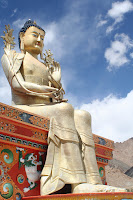
It was nearing 5 in the evening & we were in a hurry to reach Kargil before dark. We left Lamayuru & moved ahead. The sunset in the backdrop of monastery was picturesque. We were tired by the long drive. The moon was already up in the sky. Everytime we saw lights in the valley, as the vehicle went up the hills, we would wonder if that was Kargil our destination; disappointed, when we passed towns that were not Kargil. In quest for directions our driver stopped us in front of yet another monastery. It was already 8 on the watch. I got to know that this was Mulbek & the monastery had the 21 ft 2nd century Maitreya Buddha or Chamba of the Bamiyan style. This idol was so huge, that it was difficult to capture it with our lens. This was one of the few Bamiyan Buddhas left on earth after Taliban destroyed the ancient statues in Afghanistan in 2001.

Although we were all mighty tired, I urged the group to see the Bamiyan Buddha. There was only one monk serving in here. He permitted us to stay at the monastery if we needed a night halt. We thanked him & set on our journey to Kargil. We reached Kargil by 10 pm, found our hotel.

The air was different. The ambiance in the hotel was different. The way food was served was different. TV in the hotel played Al Zajeera Channel. May be it was just my mind playing up because of the blooded history & media hype. Whatever it was, with an uncanny feeling in my heart, I settled for the night in Kargil.

Next morning, we left our hotel to find Khadim. Khadim was the owner of a fleet of vehicles in Kargil. We hired TATA Winger, a 10 seater for our journey to Zanskar. After procuring the permission letters from JKTDC, we set on our way to reach Parakchik by night.

Best Regards,
Roopa Sreedhar
9886162404

© TAG INDIA www.tagindia.net

Monday, July 27, 2009

Suru Valley


Suru Valley

From Srinagar to Leh

A: Suruvalley
Kargil – Trespone – Sanku – Panikhar (70km from Kargil)
Panikhar – Tangole – Parkachik – Rangdum (130km from Kargil)

B. Zanskar Valley
Rangdum – Pensi La – Ating – Sani – Padum
B.1. Padum -
Karshe – Stongde – Zangla- Padum
B.2. Padum - Bardan - Padum

Return to Kargil for the next phase of the journey in the same route
Padum -> Rangdum -> Kargil over 2D/1N

Although Padum is closer to Leh on Map, there are no roads & no commute to Leh. One can only trek or raft his way to Leh.

The Suru valley is a valley in the Ladakh region of Jammu and Kashmir, which is drained by the Suru River (Indus), a tributary of the Indus river. It is located at a height of 3,000m. The towns of Kargil and Rangdum are located here. The Penzella Pass at Panikhar, a hill resort in Zanskar, divides the Suru valley with Zanskar. Willow and Poplar are grown in the Suru valley.

Suru valley is inhabited by 25,000 by people of Dard and Tibetan descent. The majority of the people are followers of Shi'a Islam, having converted from Tibetan Buddhism
in the 16th century
One of the most beautiful regions of Ladakh , the Suru Valley forms the mainstay of Kargil district. Lying nestled along the north-eastern foothills of the great Himalayan Wall, it extends from Kargil town, first southward for a length of about 75 Kms. Upto the expanse around Panikhar, hence eastward for another stretch of nearly 65 kms upto the foot of the Penzila watershed where the Suru valley rises. Its composite population of about 30,000, mainly of Tibeti-Darad descent are Muslims who had converted their Buddhist faith around the middle of the 16th century, under the direction of Thi-Namgyal. Buddhists in the Suru valley are dispersed throughout the valley in small numbers but are found mainly in Rangdum.


The upper valley reaches of the valley, particularly around the Sankoo bowl, the Panikhar expense and the higher stretch beyond, present a spectacle of breathtaking features-majestic mountain ramparts crowned by snow capped peaks, undulating alpine slopes draining into wild mountain streams of foaming cascades of pristine water, awesome glaciers descending along the Himalayan slopes to the river bed in riverine formation, Quaint villages of adobe houses straggling dry hillocks surrounded by large tracts of lush crops downward the patches of alpine pastures uphill. The beauty of this region is further enhanced by the sheer contrast provided by the towering peaks of Kun (7035m) and Nun (7135m) which loom over the skyline in their crystalline majesty.
The drive to Kartse Khar is well worth it as the Maitreya Statue dating back to 7th century, is similar to those destroyed by the Taliban at Bamiyan.

How to reach ?
Sankoo, Panikhar and Parachik are connected with Kargil with regular bus services, in summer even twice a day. A bus ride from Kargil takes 2 hours to Sankoo, 3 hours to Panikhar and about 4 hours to Parkachik. Rangdum is serviced by the BI-week bus service to Padum, which increases according to demand. Some trucks plying between Kargil and Padum also offers a lift in the cabin for the price of a bus seat. Cars and jeeps taxis can be hired from Kargil / Leh for visiting different places in the Suru Valley, including Rangdum and Penzila.

Where to stay?
Tourist bunglow/tents @ Purtikchey, Panikhar, Rangdum; hotels in Padum, Kargil


Best Regards,
Roopa Sreedhar