Search This Blog

Showing posts with label Kargil. Show all posts

Sunday, August 1, 2010

From Leh to Kargil in a day by Roopa Sreedhar

© TAG INDIA www.tagindia.net

On my journey to Kargil

I have lost count of the villages, towns, cities I have visited in all my travels & treks in India. Everywhere I went I felt at home & safe. I felt the vibes that I feel in my own city. I never felt out of place or my mind disturbed any time, whether it was trekking in deep jungles of Uttarkhand while on Har-ki-dun trek, or getting lost in Zanskar, even Srinagar with all its turbulence couldn’t shake my equilibrium. But Kargil was definitely a different story. Kargil is one of the most eerie places I have been to in all my travels in India.

We left Leh in the morning, spent some time at the beautiful Spituk Monastery. This one, with a Kali temple, was just on the outskirts of Leh & gave us a fantastic view of the city. After taking a bow at Gurudwara Pathar Sahib, we indulged in the famous experiment on the Magnetic stretch of the Magnetic Hill. Our vehicles were moving magically even when turned off, with an invisible force pulling them. Our next stop was a lovely break at the confluence of Indus & Zanskar rivers. The light brown of Indus merged with Green of Zanskar to flow as lighter shade of Gray with many names all the way & beyond Kargil.

Momos at the Tibetan restaurant at the quaint village of Nimmo were some of the best we had had. The landscape changed radically after Nimmo. We stopped by a fruit orchard, Giri helped us picked some apples, apricots & Leh berries. We felt we were in some ancient villages & ruins. Some views looked like scenes from Chinese movies of Himalayas. From bright sunshine, it felt like entering a cold gray zone. The other vehicle had moved ahead of us & we had a lot to catch up. We hurried behind them enjoying the lovely weather, barren landscape & snowcaped peaks staring at us.

Next on our list was the gracefully located Klu_Khil or Likir Monastery. The might golden statue of Buddha was most impressive. The buildings homing the monasteries looked the same every where, beautifully built on Tibetan Architecture, they looked like replicas of Tibetan palaces. Young monks were coming out from their school. Many small creeks of ice cold water supplied fresh water to the monastery.
We traversed our vehicles towards the ancient village of Alchi, set in the Indus valley. The narrow alleys to the temple had many walnut trees adorning the courtyards. This place was home to 2nd century temples of Buddha. The delicate yet surviving structure was very special. Their inner walls and ceilings were wonderful collages of ancient frescoes & paintings, kaleidoscope of bright colors made of vegetable & mineral dyes. Gardens with many flowering shrubs added color to this otherwise barren portrait. Most impressive were the various statues of Buddha in different colors and poses, placed to see 4 directions. We had lunch at Alchi in an apple orchard under the apple trees. This is one of our most memorable lunches. The hotel staff permitted us to pick some apples & we filled our bags with apples to last the entire trip. Gushing Indus making many high grade Rapids & milky froth tempted us to indulge in White water rafting!

We then set of to the most beautiful landscapes of Ladakh, often referred to as ‘the moonscape’ & the legendary Lamayuru Monastery. The serpentine curves leading to this place made a thrilling drive. We were sticking to our seats wishing for seat belts and gritting our teeth, and praying for a safe passage. This seemed to be a very dangerous drive up hill. The construction of Bridges by HIMANK & moving trucks only added to the thrill & scare.

Looking at the moonscapes was a very satisfying experience. This was like icing on black-forest cake. We felt very lucky to have done something that many just thought of. The cave where Naropa meditated in 4th century was hidden behind the camouflage of a book shelf in the monastery. The kind monk opened it up for us and told us the interesting story behind the legend.

Tea break at the hotel & lodging facility in the small town of Lamayuru had our energies rejuvenated. Bathrooms were bad. But atleast we knew that it would be easy to find accommodation in this village.

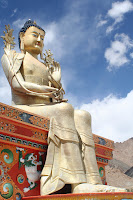
It was nearing 5 in the evening & we were in a hurry to reach Kargil before dark. We left Lamayuru & moved ahead. The sunset in the backdrop of monastery was picturesque. We were tired by the long drive. The moon was already up in the sky. Everytime we saw lights in the valley, as the vehicle went up the hills, we would wonder if that was Kargil our destination; disappointed, when we passed towns that were not Kargil. In quest for directions our driver stopped us in front of yet another monastery. It was already 8 on the watch. I got to know that this was Mulbek & the monastery had the 21 ft 2nd century Maitreya Buddha or Chamba of the Bamiyan style. This idol was so huge, that it was difficult to capture it with our lens. This was one of the few Bamiyan Buddhas left on earth after Taliban destroyed the ancient statues in Afghanistan in 2001.

Although we were all mighty tired, I urged the group to see the Bamiyan Buddha. There was only one monk serving in here. He permitted us to stay at the monastery if we needed a night halt. We thanked him & set on our journey to Kargil. We reached Kargil by 10 pm, found our hotel.

The air was different. The ambiance in the hotel was different. The way food was served was different. TV in the hotel played Al Zajeera Channel. May be it was just my mind playing up because of the blooded history & media hype. Whatever it was, with an uncanny feeling in my heart, I settled for the night in Kargil.

Next morning, we left our hotel to find Khadim. Khadim was the owner of a fleet of vehicles in Kargil. We hired TATA Winger, a 10 seater for our journey to Zanskar. After procuring the permission letters from JKTDC, we set on our way to reach Parakchik by night.

Best Regards,
Roopa Sreedhar
9886162404

© TAG INDIA www.tagindia.net

Thursday, July 29, 2010

Rescued by Indian Army @ Drang Drung Glacier - Sep 2009 by Roopa Sreedhar

© TAG INDIA www.tagindia.net

Rescued by Indian Army @ Drang Drung Glacier, Zanskar - Sep 2009 by Roopa Sreedhar

It was another glorious day of our 18 day itinerary. We were traversing in the Kargil to Padum circuit. After visiting the Bhutanese Bardan Gompa in the famous dark valley, we got back to JKTDC guest house in Padum. Craving for South Indian food had us taking over the kitchen. Pulav, Raita & yummy Puliogare adorned our brunch table. We also packed the food for the way.

As we were approaching the best view of this journey, the 22km long Drang Drung Glacier, the tyre of our TATA WINGER burst. Khadim, our driver changed the tyre. We had gone up only a few km when we felt the wobble again. To our shock, two other tyres had punctured.

The milestone we read a few minutes ago had said 3 kms. It was only 4 in the evening. We could see the Rangdum Gompa set on a hilltop faraway. But since we could see it, it did not seem to be so far away to us. We thought we could walk to Rangdum's JKTDC Guest house. So we told Khadim to get the vehicle repaired and come back for us. Or send another vehicle to pick us up. We picked up our food pack, fruits, jackets, sleeping bags, water and set on foot.

We had just walked a few steps and saw the milestone 24 km. Oooooooops! Oh My God, We had missed out a 'Zero' next to 'Three' in '30 kms'!!!!! What next???? Trepidation??? It would become dark soon. Suru river flowed silently yet speaking volumes. Our minds were equally active with unasked questions! Would we reach the next village before the light disappeared? Would Khadim come back to get us? Would we find a pickup? Would someone give us a lift? Would the God appear from behind the hills? Oh Buddha, could you hear our prayers? And on a practical note.. Would we have to sleep under some stones? Rahul had slept under a stone during his course with HIM. If he could, we could do that too in dire situation.

Far away from the horizon, we saw a cloud of dust, a glimmer of hope. The cloud of dust grew bigger & bigger as the minutes passed but did not disappear from our vision. A truck emerged in front of us. We offered a lot of money to the driver and asked him to give us a lift to Guest house. But the truck was going in the opposite direction towards Padum. He said ' what will I do with money that won't buy me anything in this isolation? Keep it!' WOW. There are something money can't buy, indeed!

We started walking again contemplating, introspecting, discussing, enjoying the scenery.
Far away, I thought I saw some houses. But the scene vanished from my vision soon & I thought I was hallucinating. Is this how it felt when mind played games? Gompa stayed wherever it was perched, tempting us to conquer it just as any peak would do.

Another cloud formed in the horizon. An army truck came out of the dust. We were hoping for a miracle. The truck passed us and went ahead. Just as we were entering into a mood of disappointment, the truck took a U-Turn and came to a stop next to us. Khadim got off the Army truck with two army men. The first thing Khadim had done was go to the nearest army camp and convince the Indian Army to pick us up. A miracle had happened!

The army men, Jogender Singh from Jammu & Hardiyal Sharma from MP dropped us to Rangdum Guest House, opened it up, ordered hot food for us from the only hotel. They told the few villagers to take good care of us & took our leave.

Khadim left for Kargil very early next morning. He came back by noon with another vehicle and spare tyres. Army men came back in time to say goodbye to us. As we went to thank Sherdeen, and give him a tip, he asked us to give him the sachets of Coffee (Nescafe) we had taken with us. He wanted to save them for any future traveler who visited him.

The honesty, bravery, selflessness and goodness of the people here touched our heart :) We met some of the best people on this trip. The time we spent in this valley is the most memorable time of the whole trip. Mesmerizing views of Nun & Kun staring down at the small village surrounded by natural fortress of green hillocks. The only hotel of the village managed by 50 year of Sherdeen. As soon as I close my eyes and think about Himalayas, I am transported to Valley of Suru at Rangdum.

Zillion Thanks to Khadim & the Indian Army!

The best way to travel in Himalayas is to take it slow & easy & let the beauty of Himalayas touch our soul like a soothing balm.


Photos @ http://picasaweb.google.com/tagindiateam/LadakhTrip2009ZanskarValleyDay12Day13#
&
http://picasaweb.google.com/tagindiateam/LadakhTrip2009ParachikSuruValleyRangdumDay11#

Best Regards,
Roopa Sreedhar

© TAG INDIA www.tagindia.net

Monday, July 27, 2009

Suru Valley


Suru Valley

From Srinagar to Leh

A: Suruvalley
Kargil – Trespone – Sanku – Panikhar (70km from Kargil)
Panikhar – Tangole – Parkachik – Rangdum (130km from Kargil)

B. Zanskar Valley
Rangdum – Pensi La – Ating – Sani – Padum
B.1. Padum -
Karshe – Stongde – Zangla- Padum
B.2. Padum - Bardan - Padum

Return to Kargil for the next phase of the journey in the same route
Padum -> Rangdum -> Kargil over 2D/1N

Although Padum is closer to Leh on Map, there are no roads & no commute to Leh. One can only trek or raft his way to Leh.

The Suru valley is a valley in the Ladakh region of Jammu and Kashmir, which is drained by the Suru River (Indus), a tributary of the Indus river. It is located at a height of 3,000m. The towns of Kargil and Rangdum are located here. The Penzella Pass at Panikhar, a hill resort in Zanskar, divides the Suru valley with Zanskar. Willow and Poplar are grown in the Suru valley.

Suru valley is inhabited by 25,000 by people of Dard and Tibetan descent. The majority of the people are followers of Shi'a Islam, having converted from Tibetan Buddhism
in the 16th century
One of the most beautiful regions of Ladakh , the Suru Valley forms the mainstay of Kargil district. Lying nestled along the north-eastern foothills of the great Himalayan Wall, it extends from Kargil town, first southward for a length of about 75 Kms. Upto the expanse around Panikhar, hence eastward for another stretch of nearly 65 kms upto the foot of the Penzila watershed where the Suru valley rises. Its composite population of about 30,000, mainly of Tibeti-Darad descent are Muslims who had converted their Buddhist faith around the middle of the 16th century, under the direction of Thi-Namgyal. Buddhists in the Suru valley are dispersed throughout the valley in small numbers but are found mainly in Rangdum.


The upper valley reaches of the valley, particularly around the Sankoo bowl, the Panikhar expense and the higher stretch beyond, present a spectacle of breathtaking features-majestic mountain ramparts crowned by snow capped peaks, undulating alpine slopes draining into wild mountain streams of foaming cascades of pristine water, awesome glaciers descending along the Himalayan slopes to the river bed in riverine formation, Quaint villages of adobe houses straggling dry hillocks surrounded by large tracts of lush crops downward the patches of alpine pastures uphill. The beauty of this region is further enhanced by the sheer contrast provided by the towering peaks of Kun (7035m) and Nun (7135m) which loom over the skyline in their crystalline majesty.
The drive to Kartse Khar is well worth it as the Maitreya Statue dating back to 7th century, is similar to those destroyed by the Taliban at Bamiyan.

How to reach ?
Sankoo, Panikhar and Parachik are connected with Kargil with regular bus services, in summer even twice a day. A bus ride from Kargil takes 2 hours to Sankoo, 3 hours to Panikhar and about 4 hours to Parkachik. Rangdum is serviced by the BI-week bus service to Padum, which increases according to demand. Some trucks plying between Kargil and Padum also offers a lift in the cabin for the price of a bus seat. Cars and jeeps taxis can be hired from Kargil / Leh for visiting different places in the Suru Valley, including Rangdum and Penzila.

Where to stay?
Tourist bunglow/tents @ Purtikchey, Panikhar, Rangdum; hotels in Padum, Kargil


Best Regards,
Roopa Sreedhar

Kargil

Kargil at an altitude of 2,704 m, 204-km from Srinagar in the west and 234-km from Leh in the east, is the second largest urban center of Ladakh and headquarters of the district of same name. It's situated in a lovely valley with apricot trees growing in the intensively cultivated fields. A quite town now, Kargil once served as important trade and transit center in the Pan Asian trade network. Numerous caravans carrying exotic merchandise comprising silk, brocade, carpets, felts, tea, poppy, ivory etc. transited in the town on their way to and from China, Tibet, Yarkand and Kashmir. The old bazaar displayed a variety of Central Asian and Tibetan commodities even after the cessation of the Central Asian trade in 1949 till these were exhausted about two decades back. Similarly the ancient trade route passing through the township was lined with several caravansaries. Now, since 1975, travelers of numerous nationalities have replaced traders of the past and Kargil has regained its importance as a center of travel related activities.

Location: 234-km From Leh in the East, Ladakh Region, and J&K
Altitude: 2,704m
Local Dialect: Purik
Historical Significance: An Important Trade And Transit Center in the Pan-Asian Trade Network.

NEARBY CITIES
Shergol: 33-km
Mulbekh: 45-km
Panikhar: 70-km
Sankoo: 42-km
Rangdum: 130-km

An Adventurers' Base Camp:
Being located in the center of the Himalayan region with tremendous potentials for adventure activities, Kargil serves as an important base for adventure tours in the heart of Himalayas. It is also the take off station for visitors to the exotic Zanskar Valley. Tourists travelling between Srinagar and Leh have to make a night halt here before starting the second leg of their journey.

The Town Life:
The town lies nestling along the rising hillside of the lower Suru basin. Two tributaries of the Suru River that meet here are the Drass and Wakha. The most astounding things about the Kargil region are the artificially irrigated field areas. Since irrigation is so important in this region, the distribution of water requires great care. Every village is divided into groups; called "Gowar", have from five to 10 families, to ensure an equitable arrangement. Willows and poplars grow beside the irrigation ditches, which lead to the terraced fields and line the road for much of its length in this region. They furnish building materials for the construction of houses in this nearly treeless land. The Kargil region actually gets more rainfall than in the rest of Ladakh and the area grows plentiful wheat, barley, and vegetables and, of course, the apricots for which it is famous. Peas have been recently introduced and are flourishing. In May the entire countryside becomes awash with fragrant white apricot blossoms while August, the ripening fruit lends it an orange hue. The dialect spoken here is called "Purik" and shows its relationship with the dialect spoken in Skardu, Pakistan. In contrast to the rest of Ladakh, the children here are taught in Arabic. A momentous occasion in Kargil is the archery contest in May.

People Of The Kargil Region:
Kashmir’s once came to the Kargil region to graze their cattle, and were followed by the tribes from Gilgit, Chitral and Mongols from Baltistan who settled there permanently. Later an Aryan tribe, the Purkpas, who now live around Drass, and the Dokpas, who are Aryan Buddhists, who live in the villages of Durchik and Gurkun, north of Kargil, drove out the Mongols.

The Customs And Lifestyles:
The Dokpas, who are Buddhists, are a community of about 700 people, descended from migrants from Gilgit, found mostly in the Indus valley villages of Durchik and Gurkun. They are known for the striking Aryan beauty of their women, and for their fair skin. They are fond of ornaments - even men wear earrings, necklaces, bracelets and strings of imitation pearls. Both sexes decorate their caps with a variety of blood red flowers, which puts them apart from all the other races in Ladakh. The Indus valley here is rich in fruit, particularly grapes, and the Dokpas delight in drink and dance - milk however is taboo. This curious mixture of Buddhist and Hindu religion means their respect for the cow is so intense that even cow dung is never used as a manure or fuel. The people grow their hair long and rarely bathe. The route to their region, over the range from Kargil to the Indus valley, and thence down to Leh, is forbidden to tourists because of the border dispute with Pakistan. The remote locality of the lower Indus villages and the custom of marrying mostly among themselves have preserved their distinctive identity. The government of a village is a seven-man council, elected by all the men. In July these villages celebrate a harvest festival, which lasts for several days. Gurdun, the main village of the region, is 80-km from Kargil.

Muta & Polyandry:
The custom of 'Muta' limited-duration marriages is still practiced in Kargil. The marriage contract signed at the wedding ceremony only applies for a limited time - in some cases only for one day. Another Tibetan marriage custom, which often strikes westerners as remarkable, is polyandry, the simultaneous marriage of more than one man to the same woman.

Today polyandry is only practiced in outlying villages like Saliskote and Trespone. In this situation a woman marries her husband's younger brothers, except for any who may be monks. Together with the great number of unmarried monks and nuns, this practice functions as a social form of birth control -from Cunningham's visit to Ladakh in the mid-19th century, up to the latest government of India census, the population of Ladakh has hardly altered.

PRIME ATTRACTIONS:
Trespone and Sankhoo are two 'Imambaras' found in Kargil. These Turkish style buildings have Persian and Arabic speaking Muslim mystics, known as "Aghas", in residence. Kargil also has a mosque, the Jami Masjid. Kargil's Muslims are noted for their extreme orthodoxy - women are conspicuously absent from the streets and all forms of entertainment are frowned on. Like the Iranians the people follow the Shi'ite sect.
The Bazaar:

The main bazaar has many Kashmiri products including embroidery, turquoises, tobacco, raw sugar and exotic spices. One will also find cloth woven from the finest wool from the long fleeced mountain goats, brass bowls, flower vases, wine cups and tall jugs, leather shoes embroidered with silk or gold silver chains, rings, bracelets and charms, paintings, Pashmina shawls, brightly colored rugs and other more Chinese looking items. Nearby Tsaluskot is the grainery of the region, attracting people from Zanskar and Leh, who come to buy grain. The houses have stone foundations and a superstructure of unbaked, heavy clay bricks.

EXCURSIONS:
Mulbek:
Situated 45-km East of Kargil on the road to Leh, Mulbek (3,230 m) in an area dominated by the Buddhists. It is situated along either banks of the Wakha River, which originates. Many monuments of the early Buddhists era dot the landscape and are accessible from the road.

Mulbek Chamba:
The chief attraction of Mulbek (also spelt as Mulbekh) is a 9 m high rock sculpture in deep relief of Maitreya, the Future Buddha. Its excursion combines esoteric Shaivite symbolism with early Buddhist art. Situated right on the highway, it dates back to the period when Buddhists missionaries came travelling east of the Himalayas.

Mulbek Gompa:
Perched atop a rocky cliff, Mulbek Gompa (monastery) dominates the valley. It is easy to see why in bygone times this site served as an outpost to guard the caravan route. Like all Buddhists monasteries frescoes and statues adorn it.

Shergol:
Another picturesque village of the Wakha River valley, Shergol is situated across the river, right of the Kargil-Leh road. The main attraction is a cave monastery which is visible from a far as a white speck against the vertically rising ochre hill from which it appears to hang out. Below this small monastery is a larger Buddhist nunnery with about a dozen incumbents. The village is accessible by the motorable road that branches off from the Kargil-Leh road, about 5-km short of Mulbek. Shergol is a convenient base for an exciting 4-day trek across the mountain range into the Suru valley. It is also the approach base for visiting Urgyan-Dzong, a meditation retreat lying deep inside the mountains surrounding the Wakha River valley. This meditation retreat lies tucked away in an amazing natural mountain fortress high up in Zanskar range. Concealed within is a circular tableland with a small monastic establishment at its center. The surrounding hillside reveals several caves where high-ranking Buddhists saints meditated in seclusion. At least one such cave is associated with the visit of Padmasambhava, the patron saint of Tibetan Buddhism. The main approach is to footpath laid through the only gap available in the rocky ramparts.

Wakha Rgyal:
Tucked away inside the picturesque upper part of the Wakha Valley, upstream of Mulbek, Royal gives the appearance of a medieval settlement of cave dwellings transported in to the modern times with some improvements and extensions. The houses, neatly whitewashed and closely stacked, are dug into the sheer face of a vertical cliff that rises high above the green valley bottom. From a far the village looks like a colony of beehives hanging from the ochre granite of the Cliffside.

HOW TO REACH THERE:
Road: The J&K SRTC operates regular buses including deluxe coaches between Srinagar and Leh/Kargil. Cars and Jeep taxis can be hired at Srinagar and Leh for Kargil. Local buses including mini coaches, for Mulbek leaves Kargil every morning and afternoon. Cars and Jeep taxis can be hired at Kargil for same day return trips. Srinagar is also well connected properly with rest of the country through Air and Road network.

WHERE TO STAY
Kargil:
There is no dearth of accommodation in Kargil. Hotels are classified into A, B, C and Economy class based upon the standard of establishments and service available. There are two Tourist Bungalows at Kargil together provide suites and furnished rooms with proper catering facilities attached with each establishment. The Tourist Office, Kargil, does advance reservation. There is also a circuit house at Baroo with excellent furnished rooms, which can be reserved through the office of the District Development Commissioner.

Mulbek:
The Tourist Bungalow here provides excellent furnished rooms with catering facilities. Dormitory accommodation at much reasonable price is available with some of the teashops near Mulbek Chamba. Alternatively tourists can return to Kargil for the night.

GENERAL INFORMATION:
Banks: The State bank of India with money changing facility and J&K bank have a branch each in Kargil.
Communication: Kargil has worldwide direct dialing telephone facility, besides post and telegraph offices. In addition J&K Tourism operates its own wireless Radio phone network with field stations at Kargil, Padum and Leh, which are connected with controlling stations at Srinagar, Delhi and Jammu. During the tourist season mobile wireless stations are also established in key places in the remote areas.

Health:
The District hospital in Kargil is fairly well equipped and staffed with a team of specialist and general practitioners. In addition there are Medical Dispensaries at Drass, Mulbek, Trespone, Sankoo, Panikhar and Padum each headed by a qualified doctor and equipped with basic health care paraphernalia.

MORE TOURIST INFORMATION:
The Tourist office here regularly updates its store of information on the region. Tourists undertaking mountaineering expedition on hard trekking along difficult routes are well advised to inform the Tourist Office at Kargil about their routes and proposed program so as to monitor their welfare.

Trekking Equipment:
The tourist office in Kargil has some trekking equipment for hire under the same conditions as the Leh office. The equipment includes a number of tents, foam mattresses, sleeping bags, alpine jackets, and rucksacks, climbing equipment and so on. Kargil is the starting point for most of the treks and journeys into the Zanskar valley, although it is also possible to enter it from other points along the side of the Leh Zanskar range.